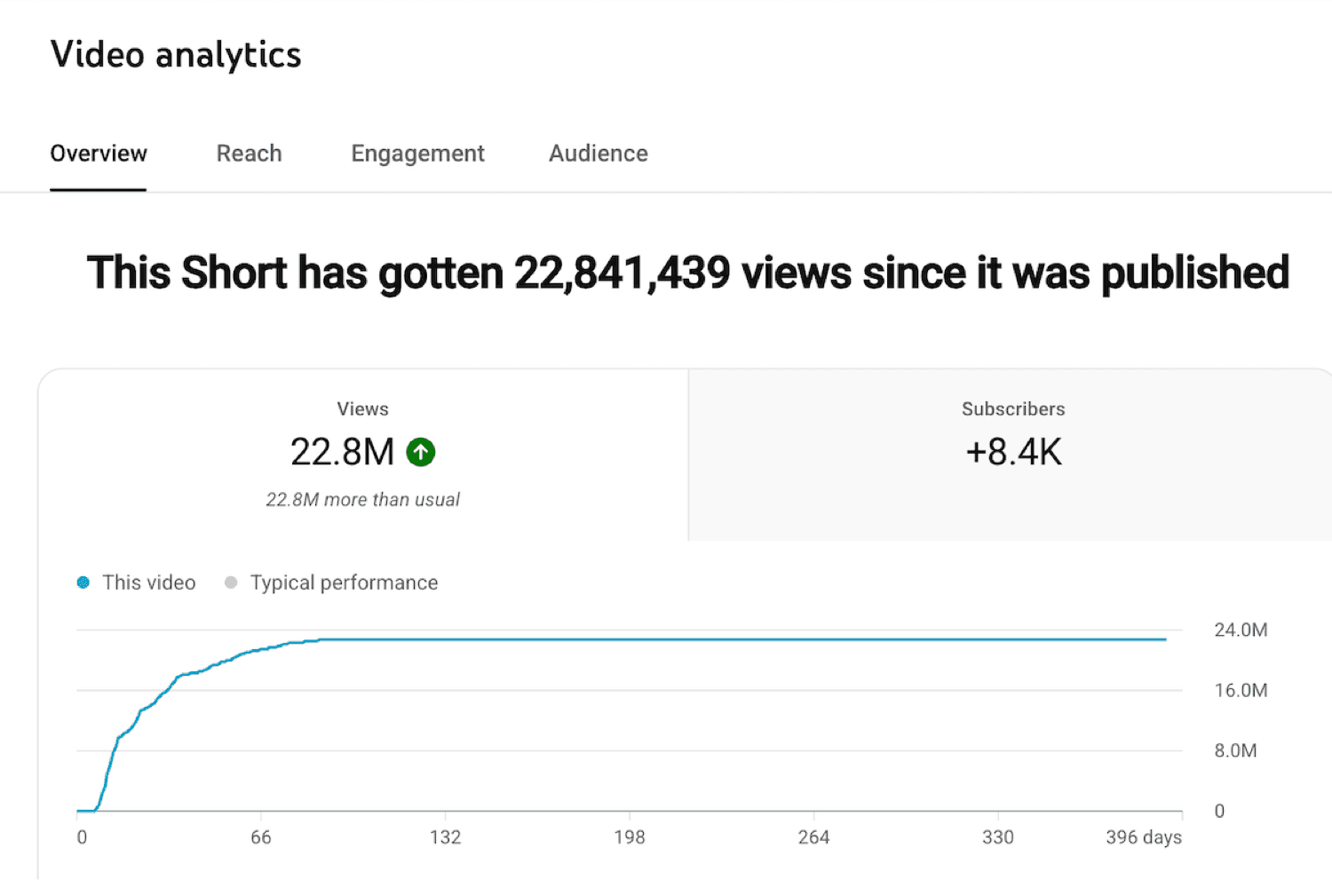
Most dental Reels get ignored for one reason: nothing in the first second tells the viewer why they should keep watching. The camera opens on a logo, a slow intro, or a dentist saying "Hi everyone, today we want to talk about…" — and the thumb is already gone. What changes it is brutally simple: a hook that lands in under a second, paired with a format the platform already wants to show. Get those two right and a single dental short can do what a year of polite, forgettable posting never will. We have seen one short reach 22.8M views, and a channel pull 23.1M views in five months. The difference was never the budget. It was the first 0.8 seconds and the idea behind them.
The 0.8-second hook is the whole game
On Reels, TikTok, and Shorts, the viewer decides whether to stay almost instantly — well before your first sentence finishes. That is why the opening frame and opening line carry more weight than everything else combined. A working hook does one of three things: it makes a bold claim ("You have been flossing wrong your entire life"), shows an unexpected visual (a cracked tooth, a before-and-after, a syringe-free numbing tool), or asks the exact question the patient is silently Googling at 11pm. What kills hooks is throat-clearing: intros, greetings, slow zooms, and "so basically." Cut all of it. Open on the most interesting frame you have, say the most interesting thing you can say, and earn the next two seconds. Then the next. A Reel is a chain of micro-decisions to keep watching, and every one of them traces back to how strong the start was.
Ideas that travel: procedures, myths, and patient questions
Reach comes from ideas that travel beyond your current followers, and in dentistry three categories travel reliably. First, procedures people are curious or anxious about — implants, root canals, veneers, wisdom-tooth removal — shown in a way that demystifies rather than horrifies. Second, myths everyone half-believes: charcoal whitening, "my teeth are just genetically bad," whether you really need to floss, what causes bad breath. Debunking a myth gives the viewer a small jolt of "wait, really?" — and that jolt is what gets the save and the share. Third, the real questions patients ask in the chair and in DMs: "Does this hurt?", "How long does it last?", "Why is this so expensive?", "Can you fix this?" Answer those plainly and you become the practice that talks like a human instead of a brochure. The best-performing dental content is not promotional. It is genuinely useful or genuinely surprising, and the practice is simply the trusted voice delivering it.
Per-platform editing: Instagram, TikTok, YouTube Shorts, Facebook
The same idea should not ship to every platform in the same cut, because each one rewards different things. On Instagram Reels, polish and a strong on-screen text hook matter, and trending-adjacent audio still helps distribution. On TikTok, raw and native beats overproduced — fast pacing, native captions, and a hook that feels like a person talking to you, not an ad. YouTube Shorts behaves more like a discovery engine and a feeder for a real channel: a clear title, a clean thumbnail-worthy frame, and a topic with lasting search interest help shorts keep earning views for weeks, which is how a channel stacks up 23.1M views in five months. Facebook skews to an older audience that is often closer to actually booking, and it tolerates slightly longer, more explanatory cuts. The mistake is treating all four as one upload button. Reframe the hook, re-cut the pacing, and rewrite the captions per platform — the core idea stays, the packaging adapts.
Do you actually need to be on camera?
This is the question that stops most practices before they start, and the honest answer is: it helps, but it is not required. A dentist or hygienist on camera builds trust faster — people choose a face they recognize — and on-camera content tends to convert better once it does reach the right person. But plenty of high-reach dental content uses none of it: screen-recorded explainers, procedure footage with voiceover, animated breakdowns, patient-question text overlays, and educational b-roll all perform. If being on camera is the blocker, do not let it block you. Start with formats that do not require your face, build the habit and the library, and add on-camera pieces later when you are comfortable. The worst-performing content is the content that never gets made because the bar was set at "studio-quality, dentist on camera, perfect lighting." Consistency beats polish.
Turning views into booked calls
Views are not the goal — booked patients are, and the two are not automatically connected. A short that reaches 22.8M views and adds 8.4K subscribers is doing the top of the job: it builds reach, authority, and a warm audience that now recognizes the practice. We've also driven medical content past 10M views and a single reel to 4.7M views / 66K likes. The bottom of the job is converting that attention into action, and that is a separate discipline: a clear next step in the caption and bio, a profile that instantly says who you treat and where, a link that goes to a real booking page (not a generic homepage), and a habit of replying to comments and DMs like a front desk that actually wants the appointment. Massive reach with a dead-end profile leaks every patient it earns. The practices that win treat the Reel as the hook and the profile-plus-follow-up as the close. Both have to be built, or the millions of views stay vanity.
Posting cadence: consistency over bursts
The algorithms reward showing up, and so do humans — familiarity is trust. A sustainable, frequent cadence beats a heroic week followed by three months of silence every single time. You do not need to post daily to win, but you do need a rhythm you can hold for months, because reach compounds: each video teaches the platform who your audience is, and a back catalog of shorts keeps surfacing long after you publish them. That compounding is exactly how a channel reaches 23.1M views in five months — not one viral fluke, but a steady stream where the winners keep working for weeks. Plan in batches so you are never starting from a blank page, keep a running list of hooks and patient questions, and protect the cadence even in busy clinical weeks. The practice that posts good-enough content consistently will out-grow the practice that posts perfect content occasionally.
Bottom line
Dental Reels fail when they bury the hook, copy-paste across platforms, and chase views with no path to a booking. They win when the first 0.8 seconds earn attention, the idea is genuinely useful or surprising, the edit fits the platform, and the profile turns reach into appointments. One short reached 22.8M views and a channel pulled 23.1M in five months — proof that the ceiling for dental content is far higher than "a few hundred views." If you want to know where your current content is leaking attention and which hooks would actually travel for your practice, we will show you in a free 5-minute AI practice audit. No pitch, just a clear read on what is working and what to fix first.